

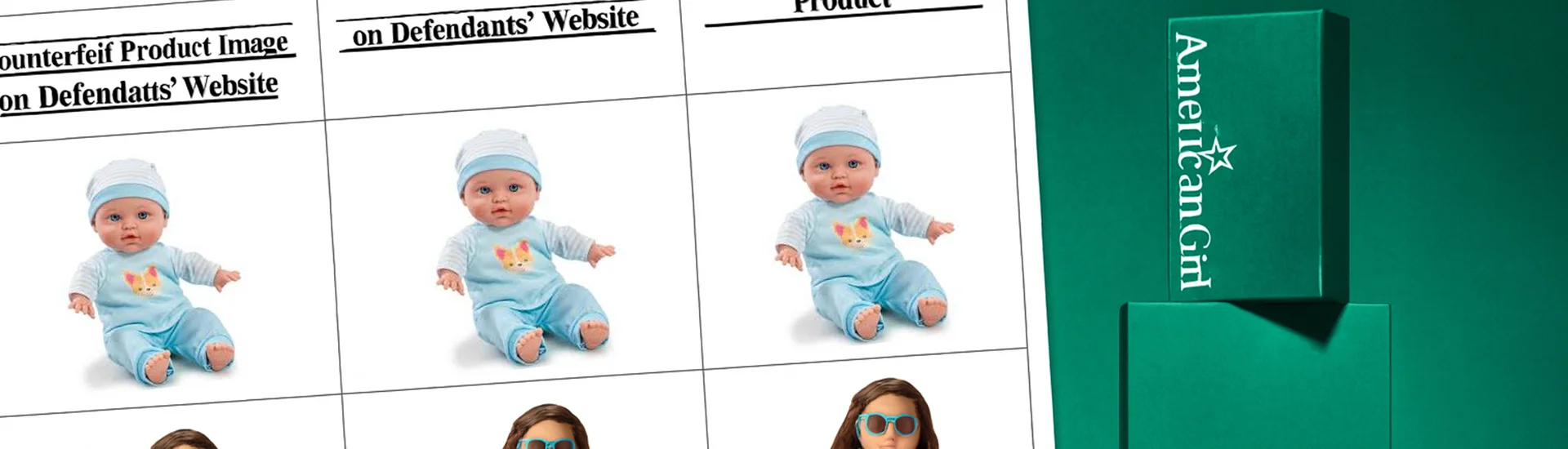
American Girl (USA) vs. Zembrka (China)
Date: September 17, 2024 — New York, USA
Summary
In a significant win for brand owners, the U.S. Court of Appeals for the Second Circuit expanded
New York’s ability to assert personal jurisdiction over foreign e-commerce sellers of counterfeits.
The case—American Girl LLC v. Zembrka—held that a seller who runs a highly interactive
website and accepts orders, processes payments, and issues confirmations has “transacted business” in
New York even if the orders are later refunded and no goods ship.
Translation: counterfeiters can’t hide behind “no delivery” technicalities.
Not legal advice. This is an information summary for brand-protection teams.
The Backstory: How the Scheme Worked
- Authentic images, fake listings: Zembrka reportedly used American Girl’s genuine product photos to market counterfeits to U.S. buyers.
- Interactive storefront: Customers could submit payment details, place orders, and receive confirmations on Zembrka’s site.
- No shipment, refunds issued: Despite refunds and no deliveries, the seller still engaged in New York transactions, the court found.
The district court initially dismissed the case for lack of jurisdiction.
On appeal, the Second Circuit reversed, emphasizing that initiating and confirming transactions
through an interactive site suffices to establish jurisdiction.
Why This Ruling Matters
- Interactivity = Exposure: If your site takes payments, confirms orders, or otherwise conducts business with New Yorkers, you can be haled into a New York court—even without completed delivery.
- Images aren’t a safe harbor: Using authentic product imagery to sell fakes is a classic online tactic; this decision helps brands fight such listings at their source.
- Broader deterrent: Foreign counterfeit rings operating “virtually” in the U.S. face greater litigation risk.
Key Takeaways for E-commerce Companies
Interactive = Jurisdiction
Sites that enable checkout, accept payments, and issue confirmations may trigger New York jurisdiction—completed shipment isn’t required.
Incomplete Transactions Still Count
Refunds or no shipment won’t shield a seller where order acceptance and payment processing already occurred.
Harden Anti-Counterfeit Controls
High-quality images fool consumers. Brands need on-product, first-party authentication that buyers can trust before purchase.
Review Legal Exposure Now
Foreign operators selling into the U.S. should reassess site flows, terms, and compliance. U.S. jurisdiction may attach earlier than expected.
Where Dupeblock Fits: Authentication That Shuts Down Counterfeits at the Source
Problem: Counterfeiters can copy photos and webpages; consumers can’t tell fakes from listings.
Solution: Make the product do the talking—instantly, from your own domain.
Dupeblock stack:
Dupeblock Copy-Proof QR
Copy-detection image embedded in the code itself. If a label is scanned/printed/re-laid out,
the micro-pattern degrades; a normal smartphone detects the loss on the first scan.
Authentication Agent (on your domain)
Host verification at brand.com/verify. Customers, distributors, marketplaces, and even platforms
can check authenticity via a trusted channel, not a spoofable landing page.
Dupeblock Verify (analytics & enforcement)
Hotspot maps, repeat-offender signals, instant alerts, code blacklisting, and exportable evidence
for takedowns and litigation support.
What Changes When You Deploy Dupeblock
- Before purchase confidence: Buyers (and marketplaces) can authenticate in seconds.
- Fewer disputes/returns: Clear pass/fail outcomes reduce friction.
- Better legal posture: Clean event logs strengthen enforcement actions.
- Marketplace ally: Provide a simple verification step marketplaces can adopt for suspicious listings.
Implementation Playbook (Fast Start)
- Place Copy-Proof QR on every sellable unit (optionally serialize for unit tracking).
- Publish brand.com/verify with the Dupeblock Authentication Agent.
- Publicize the check: product page, packaging, and order confirmation emails.
- Enable alerts & blacklisting; set thresholds for auto-flagging anomalies.
- Coordinate with marketplaces to reference your verification endpoint on disputed listings.
Conclusion: Authenticity Wins in Court—and at Checkout
The Second Circuit’s ruling is a tailwind for brands: virtual commerce still creates real jurisdiction.
Pair that legal leverage with on-product, first-party authentication and you make counterfeiting harder,
enforcement faster, and consumer trust visible at the moment of truth.
Stay protected with Dupeblock.
- Dupeblock Copy-Proof QR
- Dupeblock Authentication Agent (brand.com/verify)
- Dupeblock Verify (alerts, analytics, enforcement)
Talk to us: [email protected]