

Secure QR Codes for Anti-Counterfeiting, With Examples
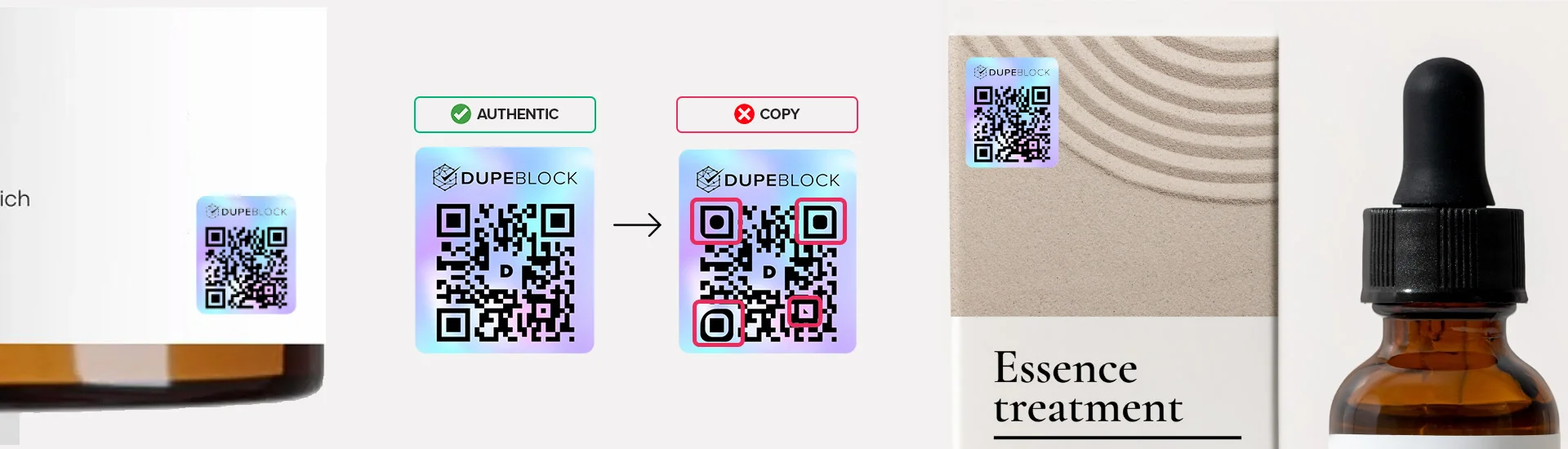
Anti-counterfeiting on product packaging is now used across major industries—lubricants, pharmaceuticals, cosmetics, electronics, and more. Different products require different approaches, but secure QR codes have emerged as one of the most scalable and cost-effective solutions thanks to modern printing, smartphone
adoption, and user familiarity with scanning. This article reviews the strengths, weaknesses, and practical use cases across all major QR-code-based
anti-counterfeiting technologies.
Not all QR codes used for anti-counterfeiting are the same. This guide draws on decades of security data to compare the most common options—and explains why secure QR codes, especially
Dupeblock Copy-Proof QR, offer the strongest, most immediate protection.
Table of Contents
- Overview: Types of QR codes used for anti-counterfeiting
- How counterfeiters typically copy packaging and QR codes
- Static and dynamic QR code security
- Serialized (unique) code security
- Dupeblock Copy-Proof QR security
- How to protect against bypass attempts
- Scan rates and consumer practicality
- How to choose the right QR solution
Overview of Common QR Code Features & Anti-Counterfeiting Utility
Of all QR types, only serialized QR codes and secure QR codes offer any security value.
- Static QR (no security)
- Dynamic QR (no security)
- Serialized QR (unit-level tracking, delayed detection)
- Secure QR (immediate authenticity checks)
Only secure QR codes allow rapid, first-scan verification of counterfeit labels.
Case Study: Rémy Cointreau
Uses secure QR codes to authenticate premium spirits and empower distributors and consumers.
How Counterfeiters Copy and Exploit Insecure QR Codes
Below is the typical pattern counterfeiters follow when packaging uses insecure (static/dynamic) QR codes:
Step-by-step:
- Counterfeiter scans the original QR code using a normal high-resolution scanner.
- Counterfeiter prints the QR directly onto counterfeit packaging.
- Customers scan the fake QR and see the same landing page as real customers.
- Brand receives polluted scan data and has no early warning.
Outcome: copied packaging passes as genuine, and the brand has no way to stop it at the point of scan.
Example: Basic QR Copying
An original QR code and a photocopy of it both resolve to the same URL—indistinguishable to the human eye and to the camera.
How Secure QR Codes Stop This
Secure QR codes embed a copy-detection image that loses information when copied or reprinted. When scanned by a consumer smartphone, it instantly reveals the counterfeit.
Counterfeit Attempt vs. Secure QR
- Counterfeiter copies secure QR onto fake packaging.
- Customer scans QR with any smartphone.
- System detects damaged micro-pattern and flags as Suspicious.
- Brand receives alert and blacklists the compromised code.
Why Static & Dynamic QR Codes Are Not Secure
Static QR Codes
Static QR codes contain an unchangeable URL. They are:
- Easy to create
- Free to copy
- Impossible to authenticate
They provide zero anti-counterfeiting value.
Dynamic QR Codes
Dynamic QR codes include a redirect URL (helpful for analytics), but:
- They are still trivially copyable.
- A copied dynamic QR still redirects to the correct destination.
- No authenticity signal is provided.
Dynamic ≠ secure.
Serialized (Unique) QR Codes
Serialized QR codes create one unique identifier per product. This helps with traceability and hotspot
detection but does not prevent counterfeiting.
They detect only after the damage occurs:
- Counterfeiter copies one label.
- Many fakes circulate using the same code.
- Brand detects unusual scan activity later and blacklists the code.
Pros
- Unit-level tracking
- Useful forensic data
Cons
- No real-time detection
- Many consumers harmed before blacklisting
Strongest Protection: Dupeblock Copy-Proof QR
Dupeblock’s Copy-Proof QR embeds a randomized, copy-resistant security image into the QR code
itself.
When counterfeiters attempt to copy packaging, this pattern degrades—making the fake detectable on first scan.
Scenario (Dupeblock + Serialization)
- Brand prints unique Dupeblock Copy-Proof QR on every unit.
- Counterfeiter copies one label.
- Customer scans fake label → fail.
- System alerts brand → code blacklisted → enforcement triggered.
Bypass Attempts: What if Counterfeiters Replace the QR?
Counterfeiters may attempt to replace your QR entirely with their own URL and website.
This is countered by two authentication paths:
1. Untrusted Channel
User scans the fake QR directly—may land on a phishing site.
2. Trusted Channel
User starts from a trusted location (website/app/social) and then scans the on-pack code.
Fake codes fail because they cannot produce valid authenticity signals.
How Practical Is Consumer Scanning?
Typical scan rates range from 1% to 20% depending on:
- Product category
- Region
- Incentives (warranty, loyalty, rewards)
- Packaging communication (“Scan to verify”)
With strong UX and incentives, scan rates can exceed 20%.
How to Choose the Right QR Security
Security Strength
- Static / dynamic (non-serialized): no protection
- Serialized: delayed detection
- Dupeblock Copy-Proof QR: immediate detection
Other Factors
- Cost & total cost of ownership
- Integration with printing equipment
- Ease of rollout
Where Dupeblock Fits In
- Dupeblock Copy-Proof QR: embedded security graphic + serialization.
- Dupeblock Direct Print: print security directly onto packaging.
- Dupeblock Verify: real-time scan validation, blacklisting, hotspot analysis, case management.
Talk to us: [email protected]